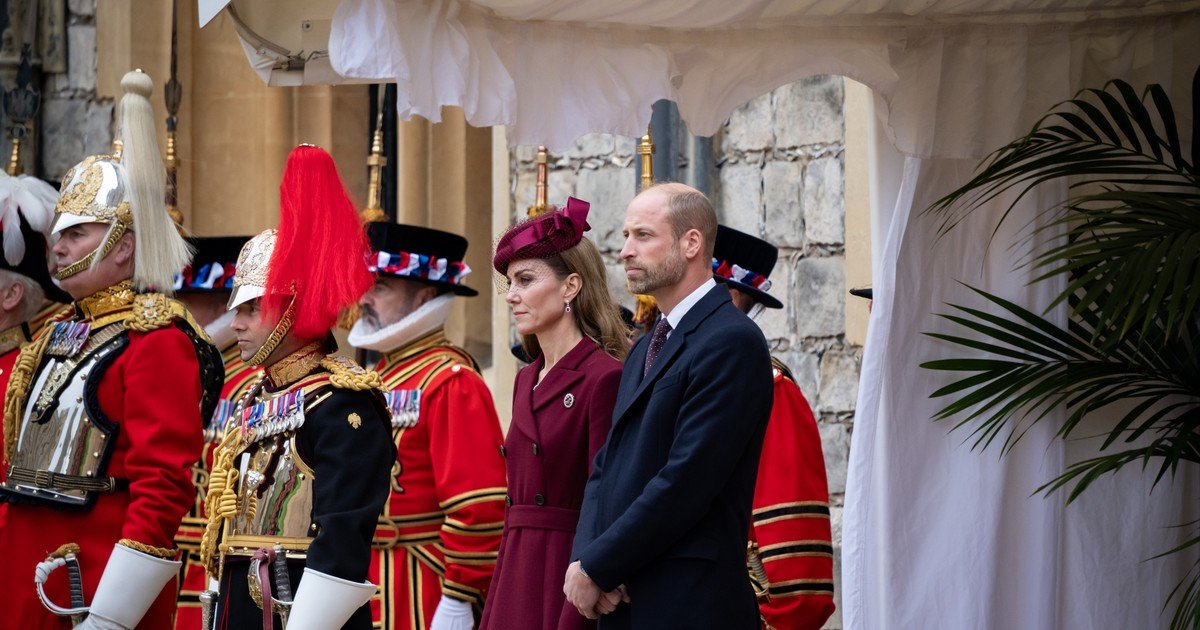
Every outfit the Princess of Wales wears to a state occasion is read like a diplomatic cable, and her deep green coat at Windsor on October 20 was fluent in the language. Kate arrived for the official welcome of Sultan Haitham bin Tarik wearing Alexander McQueen in the green of Oman’s flag — a gesture of respect delivered entirely in fabric, and the latest masterclass in the art she has made her own: diplomatic dressing.
The choice of house mattered as much as the color. The coat was designed by Sarah Burton for Alexander McQueen — the same designer, at the same house, who created Kate’s wedding dress in 2011. Royal watchers have long understood that when the Princess reaches for Burton’s McQueen on the biggest stages, she is underlining the moment’s importance with her own history. A state welcome at Windsor, standing beside the King and Queen as the monarchy received a Gulf head of state, qualified in every way.
The Millinery Detail
The finishing touch was a hat by Juliette Botterill, one of the Princess’s most trusted milliners. In British royal dressing, the hat is never an afterthought — and the profession of the milliner remains one of the quiet crafts that keep the whole visual system running. Botterill’s sculptural pieces have become part of Kate’s signature at formal occasions: structured, elegant, and deliberately never louder than the woman wearing them.
 (Presidential Executive Office of Russia / Wikimedia Commons (CC BY 4.0))
Wearing the Guest’s Colors
The green itself was the message. Oman‘s national flag carries green alongside red, white and black, and for a visiting head of state, seeing your hostess dressed in your country’s color is a compliment that requires no translator. It is one of the oldest moves in soft power: the wardrobe as welcome mat. Kate has deployed it on tours and state occasions throughout her royal life — maple leaves for Canada, shamrock shades for Ireland, national designers worn on arrival in host countries — but Tuesday’s version was particularly polished, the emerald green reading clearly in every photograph from the Royal Dais.
None of this happens by accident, and none of it is vanity. Modern royal protocol treats the senior royal woman’s wardrobe as a working tool of the state visit: it generates the photographs, the photographs carry the friendship, and the friendship greases the diplomacy happening in the meeting rooms. When commentators praised the coat, they were grading a piece of statecraft.
 (Roger Harris/House of Lords / Wikimedia Commons (CC BY 3.0))
How a Look Like This Gets Built
A coat like Tuesday’s does not happen on the morning of the visit. Royal dressing at this level is planned the way diplomacy itself is planned — briefs are exchanged, the guest nation’s symbols are studied, and the wardrobe is assembled to survive several examinations at once: the scrutiny of fashion critics, the reading of protocol experts, and the unforgiving test of the archive photograph, in which the outfit will live forever. Color comes first, because color is what survives distance and print. A deep, saturated green could be identified as Oman’s from the back row of the press pen; the tailoring and the millinery exist to make that single clear signal look effortless.
There is also the question of repetition — the discipline Kate’s wardrobe is famous for. Pieces return across years, houses are patronized faithfully, and a coat by Burton at a state welcome connects, in the minds of viewers, to every previous Burton moment from the wedding onward. That continuity is a strategy in itself: it tells the guest nation that this relationship, like this wardrobe, is not a costume change but a commitment. Fashion houses understand the arithmetic too. A single appearance at Windsor can carry a British label into front pages on five continents, which is why the Princess’s patronage is treated in the industry as a form of national promotion as much as personal style.
Even the hat participates in the message. Botterill’s sculptural piece framed the Princess’s face for the cameras without competing with the coat’s diplomatic color — the milliner’s art in service of the photograph, which is, in the end, the true medium of a modern state visit. Long after the communiqués are filed, it is the image of the welcome that circulates: the King, the Queen, the heir — and the woman in green, saying welcome in the only language every viewer on Earth reads fluently.
A Signature Fifteen Years in the Making
What made Tuesday’s look resonate is how completely it has become her signature. The Burton connection reaches back to the wedding dress that introduced Kate to the world; the diplomatic color-coding has been refined across fifteen years of tours, jubilees and state banquets. Where the late Queen Elizabeth II used bright monochrome so crowds could spot her, her grandson’s wife uses color as correspondence — each shade addressed to someone specific. At Windsor, the addressee was the Sultan of Oman, and the letter was unmistakably warm.
The day itself offered the full supporting cast: Prince William escorting the Sultan from London, the carriage procession up to the castle, gun salutes over two cities, and a state banquet machinery waiting in the wings. But as so often at these events, the image that will survive is a still photograph of a woman in green — proof that in the modern monarchy, the most effective diplomat in the room may be the one who never has to say a word.
 (The White House / Wikimedia Commons (Public domain))
It helps that the Princess has made reliability itself a style. Royal fashion at state level is a high-wire act — honored guests, historic settings, a global audience ready to grade every seam — and her record is one of almost unbroken precision: the right house, the right color, the right weight of symbolism, landing month after month and year after year. Tuesday’s green coat was not a departure or a gamble. It was the system working exactly as designed, which is precisely why it worked.
Expect the coat to be studied the way all of Kate’s state-visit looks are studied — and expect the lesson to travel. Diplomatic dressing works because it costs nothing and communicates everything: respect for the guest, pride in British design, and a monarchy confident enough to let a color do the talking. On a day built from centuries-old ritual, the newest tradition at Windsor may be the Princess of Wales getting dressed — and getting it exactly right.