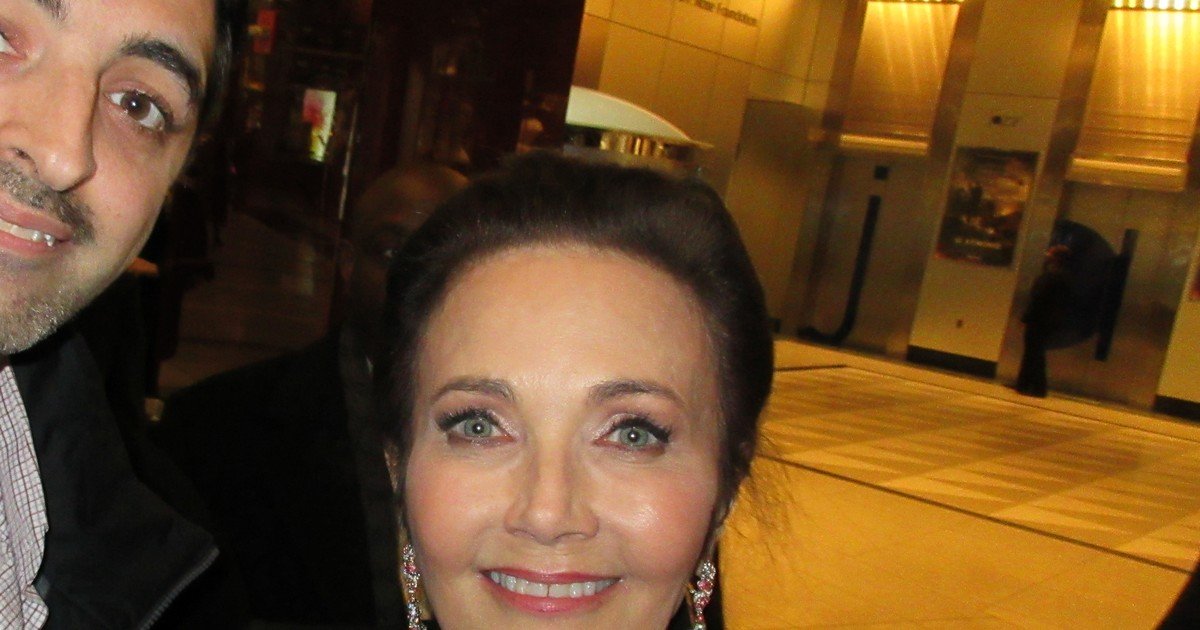
Half a century is a long time for a television role to hold its grip on the public imagination, but Lynda Carter’s Wonder Woman has never really let go. So when Carter, 75, appeared at the 28th annual Angel Ball at Cipriani Wall Street on October 19, 2026 — radiant in a sequin gown and a ruffled black cardigan — and revealed to HELLO! magazine that her skincare routine is “honestly and truly soap and water,” the moment resonated far beyond one gala. It was a reminder that the woman who taught a generation what a superhero looked like is still, in her own quiet way, setting the standard.
Carter’s place in pop culture is unusual even among icons. Her series aired in the 1970s, in an era of television history when a female-led action show was a genuine gamble, and her portrayal — warm, strong, utterly unembarrassed by its own sincerity — became the template against which every later incarnation of the character is measured. As she told PEOPLE in 2024, “People still recognize me all the time as Wonder Woman,” adding that she does not believe she has changed all that dramatically. Watching her work a red carpet in 2026, it is hard to argue.
 (CBS Photo Division / Wikimedia Commons (Public domain))
A Second Act of Careful Choices
What distinguishes Carter’s later career is restraint. She has not chased every invitation or lent her name to every revival. Instead, her appearances form a curated calendar: the Schiaparelli haute couture show at Paris Fashion Week in 2025, the Paley Honors Spring Gala, and now the Angel Ball — events where fashion, heritage and philanthropy intersect. Frequently she is accompanied by her daughter, singer Jessica Carter Altman, the two of them in coordinating outfits, which has turned her public appearances into something warmer than nostalgia: an ongoing story rather than a retrospective.
That selectivity is itself a lesson in longevity. Carter understood early that scarcity protects mystique, and that a star who appears only when the occasion deserves her will always be greeted as an occasion. The result is that at 75 she is not a “former” anything. She is a working symbol of timeless style, and a role model for performers wondering how to grow older in an industry that rarely rewards it.
Why the Soap Quote Matters
It would be easy to treat the skincare revelation as a charming aside, but it fits the larger pattern of Carter’s public life. At a moment when beauty culture grows ever more elaborate — and ever more expensive — her insistence on clear soap and water reads as a small act of independence, entirely in character for the woman who played the most independent heroine on television. It also reframes the conversation around her appearance: the interesting story was never the products. It is the posture — upright, unbothered, self-possessed — that she has carried from the soundstages of the 1970s to a charity ball in 2026.
 (White House Photographic Office / Wikimedia Commons (Public domain))
What comes next for Carter is, as ever, her choice. If the pattern holds, there will be a handful of appearances each year, chosen with care, each greeted like a state visit from entertainment royalty — and the red carpet fashion world will keep a space permanently reserved for her. Heritage institutions will keep honouring the series that made her famous, new generations will keep discovering it, and somewhere in the middle of it all she will keep washing her face with soap and water, unbothered and luminous.
 (Geraldshields11 / Wikimedia Commons (CC BY-SA 4.0))
That, in the end, may be the most useful way to read the Angel Ball photographs. They are not a comeback and not a farewell. They are one more page in an unusually graceful ongoing story: the superhero grew up, grew older, and never stopped being super. The rest of us can only take notes — and perhaps simplify the bathroom shelf.
A Blueprint Others Keep Borrowing
Younger performers study careers like Carter’s the way architects study old buildings — looking for the decisions that made them last. The load-bearing choices are visible. She never publicly resented the role that made her famous, so the role never became her cage. She kept her private life substantially private, so the public’s affection never curdled into overfamiliarity. She showed up, decade after decade, looking like herself rather than like a negotiation with herself — and when the culture’s beauty conversation grew frantic, her calm became more valuable, not less. The soap-and-water remark is only the latest and most quotable expression of a strategy that has been running, quietly and successfully, since the 1970s.
There is a generational handover embedded in her appearances, too. When she attends events with Jessica Carter Altman, fashion watchers see a star and her daughter; longer view, they are watching an icon demonstrate how fame can be carried inside a family without deforming it — shared on good nights, set aside on ordinary ones. That may prove to be her most imitated legacy. The tiara was always the least of it. What Carter modelled, then and now, is a way of being looked at for fifty years and remaining, unmistakably, the person doing the looking back.
Anniversaries will keep arriving — of the series, of the character, of her own milestones — and each will test whether the culture still cares. The evidence from Cipriani Wall Street suggests the question answers itself. A single red carpet appearance, at 75, generated the kind of affectionate global attention that publicists dream about and cannot manufacture. Carter does not need to chase the future of her legacy. Judging by the reaction to one sequin gown and one bar of soap, the future is coming to her, on schedule, as it has for half a century.
If there is a single sentence that summarises the whole phenomenon, it may be the one she offered almost as an aside: people still recognise her. Recognition, sustained across fifty years of changing tastes, is not an accident of casting. It is the compound interest of consistency — and Carter, radiant at 75, is still collecting it.