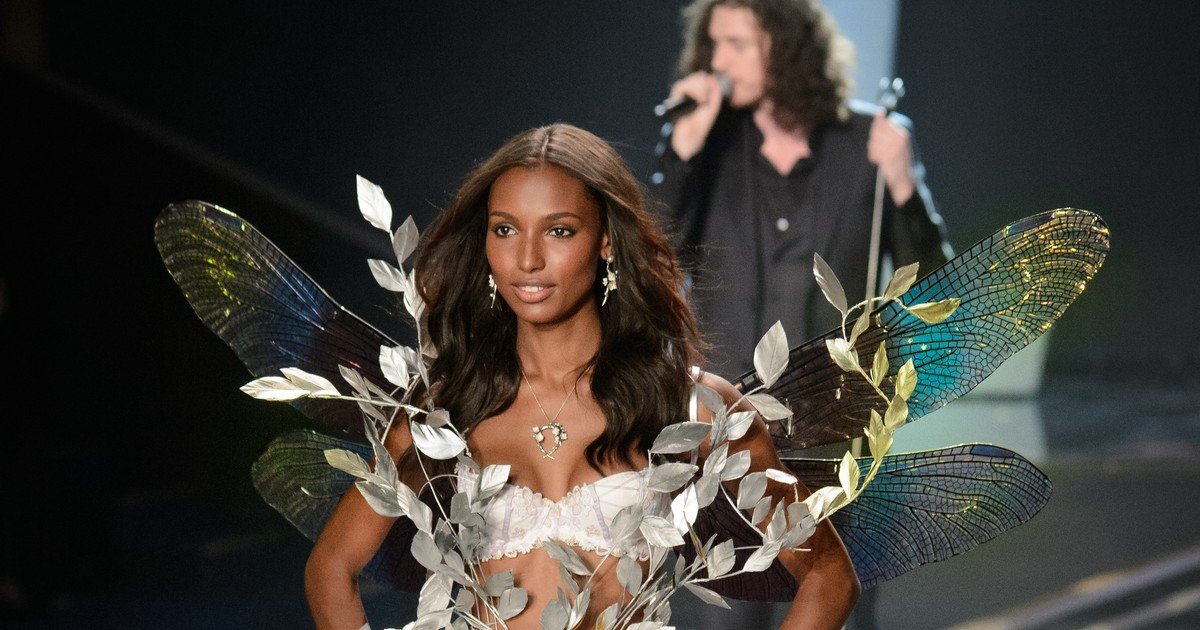
There was a time when a Victoria’s Secret Angel’s wings were an accessory. That time is over. This year’s show put Elsa Hosk in a 70-inch pair of welded-steel wings — nearly six feet of wing design — while Jasmine Tookes carried some of the heaviest wings of the night and Gigi Hadid reminded everyone that modern wings can top 75 pounds. The wings didn’t just get bigger. They became the show. How did we get here?
The OG Era: Wings as Jewelry
When Gisele Bündchen walked her last Victoria’s Secret show in 2006, wings were still essentially oversized accessories — pretty, certainly, but built for beauty rather than spectacle. The runway look of that era was about the model first: the wings framed her, they didn’t swallow her. The Fantasy Bra years kept the focus on jewels and craftsmanship at a human scale. A great walk, a great body, a great pair of wings — in that order.
 (Mathieu Lebreton from Paris, France / Wikimedia Commons (CC BY 2.0))
The Scale Era Begins
Somewhere in the show’s modern revival, the brief changed. Wings stopped being something a model wore and became something a model operated. The metal framework got serious — welded steel skeletons replacing wire and hope. Featherwork went from decoration to construction, with hundreds of individual feathers placed by hand over the frame. The show production scaled up to match: longer runways, mirrored floors, industrial fans for drama. Each year the signature image — the one that travels the world — is the biggest pair of wings. So each year, the wings get bigger.
The Physics Problem
Here’s what the audience doesn’t feel: a 10-foot wingspan is a sail. Add the gust of runway fans and a model is doing aerodynamic management in stilettos on a mirrored runway. The finale look — the biggest wings, saved for last — is also the hardest walk of the night, performed when the model is most tired. Tookes said as much this week, noting critics had judged her on footage from the exhausted end of her pass. The job now requires the core strength of an athlete and the balance of a dancer, on top of everything modeling always demanded.
 (Mathieu Lebreton from Paris, France / Wikimedia Commons (CC BY 2.0))
The Mothers Changed the Math
This year’s show also made a quieter statement: Hosk walked it months after welcoming her second child, part of a postpartum runway moment that reframes what a show body can be. There’s something fitting about the timing — just as the wings reached their most extreme, the models carrying them became more human, more real. The advocacy from Hadid this week was part of that shift: a demand to see the labor, not just the image.
Where Does It End?
Every era of the show has had its signature excess, and every era has eventually corrected. The question now is whether the wing arms race has a ceiling — physical, if not aesthetic. At 75-plus pounds and 10-plus feet, with animatronic elements entering the mix, the wings are approaching the limits of what a human body can carry down a runway. The next evolution might not be bigger at all. It might be smarter: lighter materials, better engineering, wings that move with the model instead of against her.
 (PhilipRomanoPhoto / Wikimedia Commons (CC BY 4.0))
Or the show might just keep going bigger, because the viewers — as Hadid noted — love it. Either way, the wings have already won. They started as decoration. They became the headline. And somewhere along the way, they turned the models who carry them into the strongest athletes on any runway in the world.
What the Fans Actually Want
Here’s the uncomfortable truth behind the arms race: it works. The wings keep getting bigger because, as Hadid herself admitted, “the viewers love it.” The most-shared images from every recent show are the most extreme pairs — the ones that look impossible, the ones that make you wonder how anyone walks in them. Social media doesn’t reward subtlety; it rewards spectacle. And spectacle, in the economy of the modern fashion show, is measured in inches and pounds.
That creates a strange contract between the audience and the models. Viewers demand the impossible — wings bigger, walks longer, moments more dramatic — and then critique the humans inside the hardware for not making it look easy. The models, to their credit, keep delivering: Hosk carried 70 inches like it was nothing, Tookes shouldered the heaviest pair of the night, and both walked back out for the finale. The fans got their spectacle. The least the internet can offer in return is a little perspective — and maybe, next time, applause instead of a comparison.
None of this is to say the spectacle should stop. There’s genuine artistry in a 70-inch wing — in the welding, the featherwork, the sheer ambition of it — and the models who carry these creations are doing something remarkable. The point is simply to watch with open eyes: to see the steel inside the feathers, the athlete inside the angel, the work inside the wonder. Do that, and the show gets better, not worse. Spectacle you understand is spectacle you can actually enjoy.