Most celebrity couples mark a milestone anniversary with a dinner and a tasteful photo. Clint Black and Lisa Hartman marked their 35th — traditionally the coral anniversary — by stepping into a recording booth of a different kind: as executive producers and on-screen relationship gurus in a Lifetime movie named after their own most famous love song. The 2026 film “When I Said I Do” is the latest reinvention in a partnership that has been quietly reinventing itself for three and a half decades.
The movie’s conceit is almost too perfect. Black and Hartman appear in cameo roles as hosts of a relationship-advice podcast — a married couple dispensing wisdom to lovers, played by a married couple whose 1999 duet of the same name became a standard at real weddings. As an executive producer credit, it is savvy. As a piece of self-mythology, it is earned. Few couples in country music could plausibly headline a film about making love last; these two have the documentation.
The Song That Would Not Retire
“When I Said I Do” was released in 1999, eight years into the marriage, and it distilled the couple’s public image into four minutes: devotion as a daily practice rather than a grand gesture. The song has been licensed, covered and played at anniversaries ever since, and the decision to build a 2026 movie around its title shows how durable the brand of this marriage has become. Where other legacy acts license their catalogs, the Blacks licensed their own love story — with themselves attached.
It also keeps the family business in the family. Daughter Lily Pearl, now in her twenties and a performer in her own right, has become a fixture of her parents’ stage show, and the couple’s Mostly Hits & the Mrs. Tour effectively turned their domestic life into a traveling production. The power couple label gets thrown around loosely in entertainment; in their case it describes an actual working structure, with the marriage at the center of the enterprise rather than adjacent to it.
 (Dwight McCann / Wikimedia Commons (CC BY-SA 2.5))
What 35 Years Actually Looks Like
Part of the fascination with this anniversary is how unremarkable the couple makes longevity look. The family photos circulating for the milestone — award shows, star ceremonies, tour stages — show two people who seem to have treated fame as a job and marriage as the life around it. In an industry that now documents relationships in real time and monetizes their collapse, the Blacks’ comparative privacy reads almost radical. They shared the highlights and kept the rest, and the highlights were enough.
There is a generational angle, too. Fans who bought “When I Said I Do” as newlyweds in 1999 are now celebrating anniversaries of their own, and the couple has aged into a kind of proof of concept — marriage goals with a 35-year evidence file. The 2025 BMI Icon celebration, with Lily at their side, and this year’s movie both suggest a family consciously curating a legacy: not just the songs, but the story the songs were always about.
 (John Mathew Smith / Wikimedia Commons (CC BY-SA 2.0))
The Next Verse
So what comes after the coral anniversary for country music’s model couple? If the pattern holds, more of the same, in the best sense: selective performances, family on stage, and projects that fold their history into something new. The tour continues to pair his catalog with their duets; the movie introduces their story to a streaming-era audience that may know the song better than the singers. An encore is usually a performer’s trick, but for the Blacks it has become a life strategy — keep returning, together, for one more song.
Thirty-five years after a wedding that followed a whirlwind courtship, the verdict of the public record is unusually simple. The gamble worked. Clint Black and Lisa Hartman did not just write one of country’s great love songs; they spent three and a half decades providing the footnotes, the photographs and now the film to prove it was true.
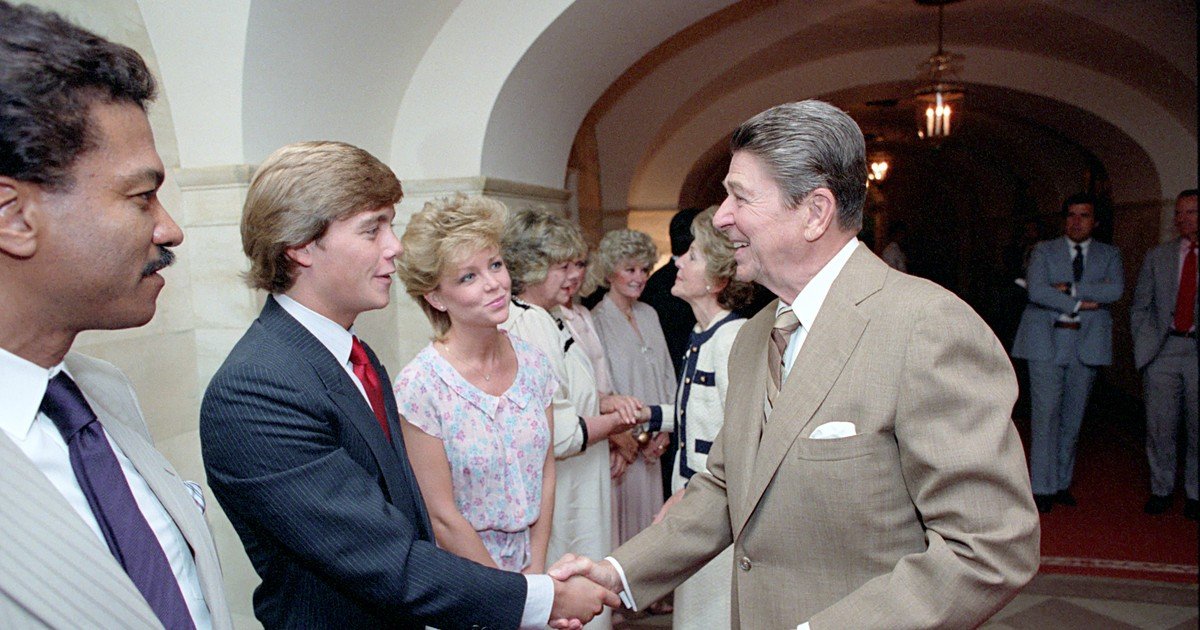
 (White House / Wikimedia Commons (Public domain))
The podcast-host premise deserves a second look, because it is smarter than it first appears. Relationship podcasts thrive on hosts whose credibility comes from survival rather than theory, and a couple approaching four decades of marriage brings receipts that no script can manufacture. By casting themselves as the advice-givers, Black and Hartman are effectively narrating their own myth in real time — and, shrewdly, introducing it to audiences who stream movies the way earlier generations bought duet albums at the record store.
There is business logic underneath the sentiment, too. Catalog songs earn when they are rediscovered, and a film title does for “When I Said I Do” what a prestige placement does for a younger artist: it sends new listeners looking for the original recording. The difference is that the original artists are also the film’s producers and its on-screen moral authority. It is vertical integration, country style — the marriage, the music and the movie all reinforcing one another, with the family at the center of every layer.
Anniversaries, in the modern music business, are also opportunities, and the couple has treated this one accordingly — not with a farewell lap or a nostalgia package, but with forward motion. A movie in 2026, a daughter stepping into the act, a catalog song returning to the center of the story: each element points the audience back to the others. It is the same instinct that built the marriage itself, applied to its commemoration. Nothing is wasted, everything is shared, and the next project is already an excuse to stand on a stage together again.
For younger artists watching from the cheap seats, the case study is invaluable precisely because it is undramatic. No reinvention scandals, no public reconciliations, no brand pivots — just a couple who treated their marriage as the main project and their careers as its longest-running collaborations, and who now, at 35 years, are converting that patience into a film, a tour and a family business with a second generation warming up in the wings.