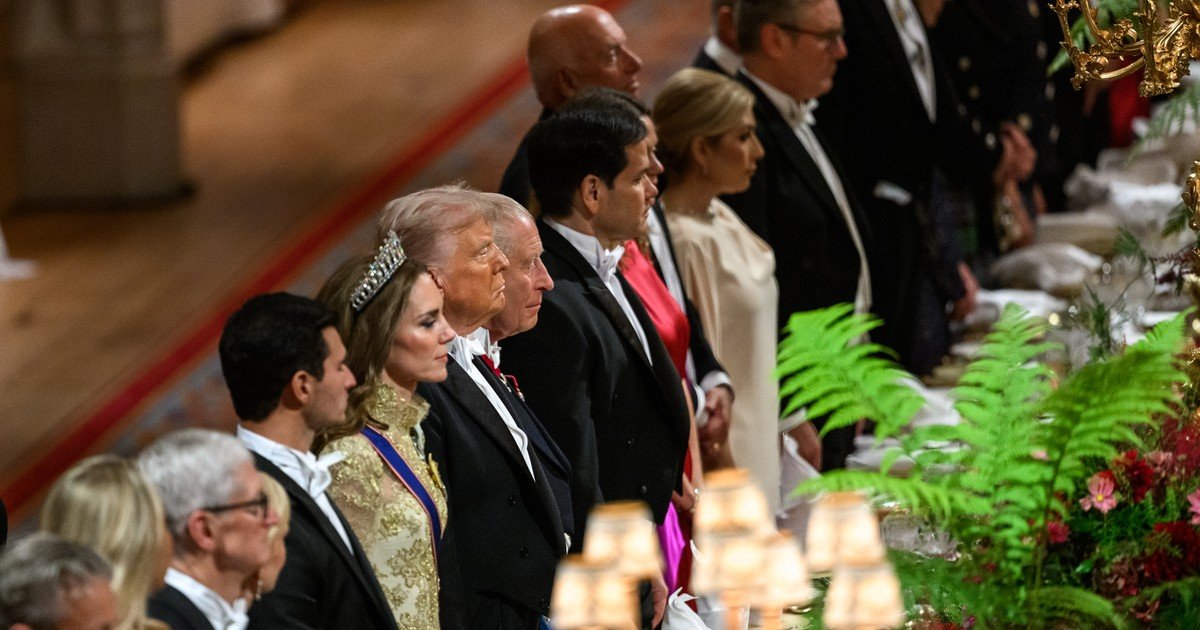
Somewhere in the planning of every state banquet there is a document nobody publishes: the Banquet Seating Plan. At Windsor Castle on October 20 it placed the Princess of Wales beside Sultan Haitham bin Tarik, the guest of honour, with Prince William across the table — the seats of maximum trust at the Head Table. What the plan could not govern was the furniture. As King Charles stood to speak to 160 guests in St George’s Hall, part of Kate Middleton’s yellow gown was resting beneath her chair leg, and the banquet’s most famous moment became one its hosts never witnessed.
To understand why the detail travelled, you have to understand the evening around it. A Diplomatic Visit at this level is theatre with a purpose: white tie, historic jewels, a sovereign’s speech and a hall built to intimidate pleasantly. The Yellow Gown — Elie Saab, braided neckline, keyhole cutout, cape in full flow — was chosen for that stage, lit by candles and surrounded by the heraldry of centuries. Against that backdrop, a trapped fold of fabric is not a scandal. It is the one unscripted thing in a night of total scripting, and unscripted things are what audiences hunt for.
Decoding the Dressing
Royal state dressing is a language, and Tuesday’s sentence was fluent. The Heirloom Jewelry came from deep in the family vault: Queen Mary’s Lover’s Knot Tiara, and earrings and a bracelet from the Late Queen’s Jewels, worn so that the late Queen Elizabeth was, in a sense, present at her son’s banquet. Add the King’s Royal Family Order and the Royal Victorian Order sash, and the Princess of Wales arrived as a walking diagram of the monarchy’s continuity — past, present and host, in one seat.
That density of meaning is precisely why the chair story delighted people rather than embarrassing anyone. Perfection that dense invites a pinprick. The gown supplied it at floor level, harmlessly, and in doing so made the whole magnificent arrangement feel — briefly, enjoyably — real.
 (The White House / Wikimedia Commons (Public domain))
The Etiquette of Not Noticing
There is a discipline to evenings like this, and Banquet Etiquette covers even the accidents. A guest at the top table does not fuss with her dress during the Monarch’s Address; she does not glance down, signal staff or interrupt conversation with a head of state. Whether instinct or pure luck, the Princess of Wales executed the protocol perfectly by remaining, apparently, entirely unaware. The Sultan beside her noticed nothing. The King spoke on. The only people who experienced the drama were watching a screen.
Hello!’s follow-up report supplied the closing fact: she was later seen standing with no issue. The gown had never truly imprisoned her; the chair’s claim on the cape was as temporary as it was photogenic. In the taxonomy of royal incidents, that makes the episode a near-miss of the gentlest kind — the sort that ends in fondness rather than statements.
Why Windsor Keeps Producing These Moments
A Windsor Castle Banquet concentrates more protocol per square metre than almost any event on Earth: 160 guests, a hall of arms and banners, staff drilled to the second. Concentration creates contrast. The more completely an evening is controlled, the more a single loose thread — or loose fold — stands out to the millions now invited, via livestream, to watch from above. Sultan Haitham came to Britain for an affirmation of partnership; he also, without knowing it, attended the internet’s favourite demonstration that royal polish and human accident can share a chair.
The monarchy will not mind. Institutions that survive centuries learn to value the small, warm story that makes the big, cold ceremony approachable. Future accounts of the Oman state visit will list the speeches and the guest list. The one people will actually tell each other is about the yellow dress and the chair — proof that even inside St George’s Hall, gravity remains gloriously democratic.
 (Presidential Executive Office of Russia / Wikimedia Commons (CC BY 4.0))
 (The White House / Wikimedia Commons (Public domain))
There is also the question of why this princess, specifically, attracts this genre of story. Catherine’s public image is built on preparation so thorough that mishaps around her register as novelties — the gust of wind managed, the heel in the grating freed with a smile. A wardrobe near-miss at a state banquet fits the pattern: the interest lies not in anything going wrong, but in how completely the machinery of her professionalism prevents “wrong” from becoming visible. The chair story is, paradoxically, a compliment disguised as an incident.
Diplomatically, the evening’s substance should not be lost under its anecdote. State visits between Britain and Oman rest on decades of defence, trade and personal ties between the two royal families, and the banquet’s grandeur is itself a message of priority. The Princess of Wales’s seat beside the Sultan was part of that message — seniority deployed as courtesy. That the courtesy was delivered, all evening, by a woman quietly anchored to her own chair only adds a footnote the historians of protocol will enjoy more than most.
Finally, spare a thought for the livestream viewers, the accidental authors of this story. A decade ago the moment would have existed for no one: unseen in the room, unrecorded beyond it. Now, the most-watched pair of eyes at a state banquet belongs to the public, patiently scanning the edges of the frame for life. On Tuesday, life was exactly where it always hides at grand occasions — at ground level, in yellow, holding perfectly still.
None of it diminished the evening’s purpose. If anything, the gentle comedy underlined how successfully the visit had humanised a formal alliance — the photograph most Britons will keep from the Sultan’s trip shows not a negotiating table but a princess, a banquet and a dress with ambitions of its own.