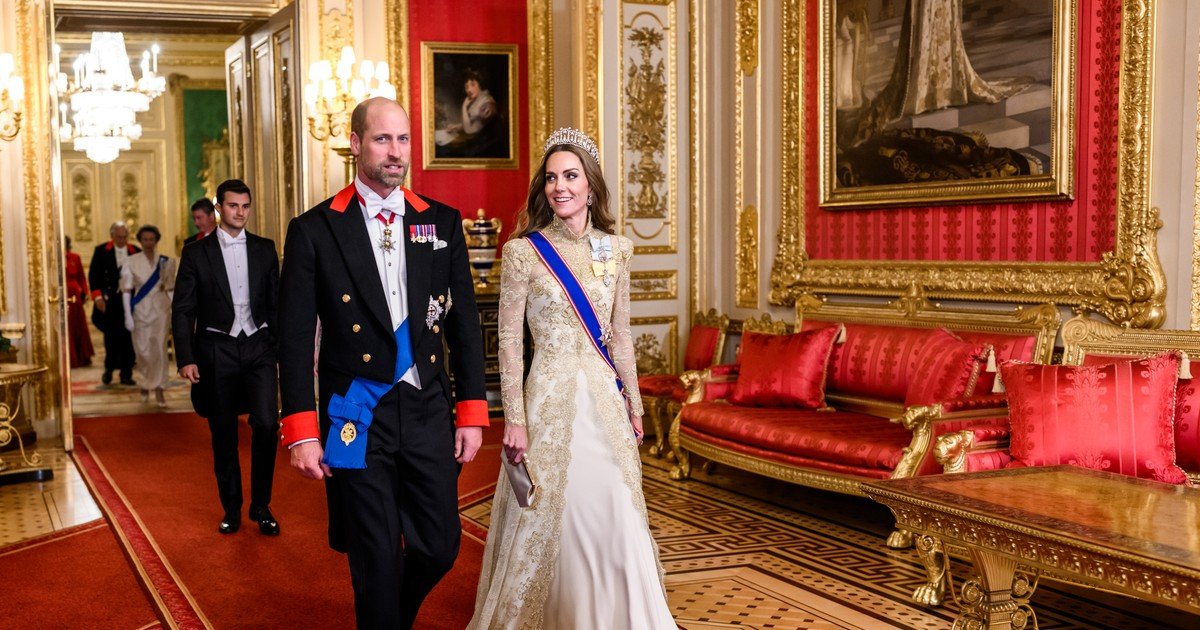
Let us consider what, exactly, the Princess of Wales did wrong at the Oman state banquet: nothing, visibly, at any point, including the point at which her dress was trapped under a chair. That is the story. Not the snag — the absence of reaction to the snag. In an age when public figures flinch on camera at the slightest irregularity, Kate Middleton sat beside a sultan, under a tiara, inside a gown with a mind of its own, and radiated the particular calm that the British monarchy has spent a century branding as its core product.
The facts bear repeating because they are so undramatic. Yellow Elie Saab, flowing cape, Windsor Castle, 160 guests, the King rising to speak — and a fold of fabric under a chair leg, spotted by livestream viewers and by absolutely nobody whose job was to be in the room. She was later seen standing without difficulty. The incident lasted as long as a rumour and left exactly no trace except a very good anecdote.
Composure Is a Skill, Not a Personality Trait
Royal Composure is often mistaken for temperament, as if some people are simply born unbothered. Watching the Princess of Wales work, it looks more like training: the stillness of the hands, the attention kept on the person speaking, the refusal to audit one’s own outfit mid-ceremony. A Gown Train or cape adds yards of unmanaged fabric to that discipline. Designers deliver the drama; the wearer delivers the risk management, at walking pace, in heels, among furniture.
The Chair Leg Mishap is therefore best read as a passed examination. The conditions were maximally unforgiving — head of state to the left, sovereign on his feet, cameras everywhere — and the candidate never knew she was being tested. That is either luck or the deepest kind of preparation. With this particular royal, whose public record contains no visible panic across fifteen years of scrutiny, the charitable and probable answer is preparation wearing the disguise of luck.
 (The White House / Wikimedia Commons (Public domain))
The Internet’s Role: Magnifying Glass, Not Villain
It is tempting to scold the livestream audience for hunting flaws in a state occasion, but the Viral Royal Moment they manufactured was affectionate. Nobody shared the clip to mock the princess; they shared it because the contrast — ultimate ceremony, tiny mishap — is the exact shape of the monarchy’s modern appeal. The institution supplies the pageantry. The audience supplies the warmth by finding the human scale inside it. An Eyewitness Report later confirming she stood up perfectly fine only completed the little narrative: jeopardy, dignity, happy ending, all inside one fold of yellow silk.
This is, when you think about it, the healthiest possible bargain between a royal family and the internet. The clip harmed no one, flattered its subject and gave a diplomatic dinner a reach its organisers could never have scheduled. If all viral royal moments were this gentle, the palace press office would sleep considerably better.
Grace, Defined Operationally
Grace Under Pressure is usually tested by events people can see. The banquet suggests a purer definition: grace is what remains when something goes slightly wrong and nobody’s behaviour changes at all. The Cape Silhouette that caused the trouble is also the signature of her state-evening style — she accepts the small physical risk of all that flowing fabric because the visual authority is worth it. On Tuesday the bill for that choice arrived, discreetly, under a chair, and her style absorbed it without interest.
There is a lesson in the Royal Jewelry Vault end of the outfit, too. She wore three generations of monarchy that night — Queen Mary’s tiara, Queen Elizabeth’s jewels, King Charles’s order — garments and gems that have survived a century of banquets, photographs and, presumably, furniture. Britain-Oman Relations will be advanced by trade talks and treaties, but their public face this week was a princess in inherited diamonds, utterly unruffled. Heritage, worn lightly, is the whole strategy.
 (U.S. Department of State from United States / Wikimedia Commons (Public domain))
The Verdict of the Yellow Dress
When the histories of Princess of Wales Style are written, the Oman banquet look will be filed as a success that a chair tried, and failed, to annotate. The gown did its diplomatic work, the jewels did their dynastic work, and the wearer did the hardest work of all: nothing, beautifully, at exactly the moment nothing was required. If your dress is going to be trapped at a state banquet, that is the way to be trapped in it — and the rest of us, who trip over our own hems in private, can only applaud from a safe, furniture-free distance.
 (William James Bennett / Charles Wild / Wikimedia Commons (Public domain))
It is also worth asking why the moment endeared her to people rather than feeding the usual cycle of royal mockery. Part of the answer is scale. The mishap was small enough to be safe — nobody fell, nothing tore, no protocol shattered — and small mishaps invite affection in a way large ones invite commentary. But part of it is accumulated trust. Audiences extend warmth to public figures whose behaviour they can predict, and after fifteen years the prediction here was easy: whatever the dress did, she would carry on. She did. The clip is beloved because it confirmed what everyone already believed.
Somewhere in Windsor there is a chair that has held a future queen’s gown and told no one. It will presumably hold other guests, at other banquets, in perfect anonymity. But for one evening it shared the frame with a king’s speech and a sultan’s visit, and it taught the internet’s favourite royal lesson of the autumn: that true poise is not the absence of mishaps. It is the presence of mind — or the excellent training — to let them pass entirely beneath notice.
That, in the end, is the whole performance.