The most telling royal appearance of Thursday, Oct. 15 was the one nobody saw. While King Charles and Queen Camilla opened the Welsh Parliament in Cardiff and Prince Harry and Meghan Markle visited charities in Nottingham, Prince William and Princess Kate slipped into the Cornish community of Nansledan, did a full day’s work, and slipped out again — with the news released only the next day. In royal terms, that silence was not an accident. It was the message.
The monarchy runs on an unwritten rule: the sovereign’s big days belong to the sovereign. A Wales engagement announced in advance would have competed for front pages with Charles’s ceremony at the Senedd, the Welsh Parliament he was formally opening. So the Prince and Princess of Wales applied the oldest strategy in the royal playbook — “keep calm and carry on” — and let the King’s day be the King’s.
What They Were Doing in Cornwall
The visit was no holiday. Nansledan is a community built under the Duchy of Cornwall, the estate William inherited with his title, and the couple travelled there to launch a new initiative pairing Kate’s Centre for Early Childhood with the Duchy itself. The project will examine how nature can support the healthy development of babies and young children — bringing together Kate’s decade of work on the early years with the Duchy’s land, housing and community expertise.
 (12121343A / Wikimedia Commons (CC BY-SA 4.0))
The pairing is significant. Kate’s early-years work has always rested on a scientific claim — that the first five years of life shape the adult a child becomes — and on a practical one: that communities can be designed to help rather than hinder. A purpose-built Duchy community in Cornwall is a living laboratory for both ideas, and linking her research centre to it suggests the project is meant to produce evidence, not just photographs.
The Discipline of the Low-Key Visit
A low-key visit is harder to execute than a grand one. There is no advance press call to guarantee coverage, no crowd barriers, no pooled photographers — just local families, project staff and the work itself, with the palace releasing details once the couple is home. The format suits the Waleses’ long-stated preference: fewer, deeper engagements, chosen for impact rather than column inches. It also, quietly, guarantees that when the story does land, it lands alone, unopposed by any rival headline from the same news cycle.
There is a counterfactual worth noting. Had the visit been announced in advance, the day’s coverage would have split three ways, and the familiar narrative — Wales versus Sussex, Wales versus King — would have written itself. By sequencing the announcement a day later, the palace converted a potential clash into a relay: Charles’s ceremony led Thursday’s news, the Sussexes’ Nottingham photographs shared it gracefully, and Kate’s childhood initiative owned Friday outright. Whoever planned that sequence understands modern media as well as any newsroom.
 (Roger Harris / Wikimedia Commons (CC BY 3.0))
Meanwhile, in Wales and Nottingham
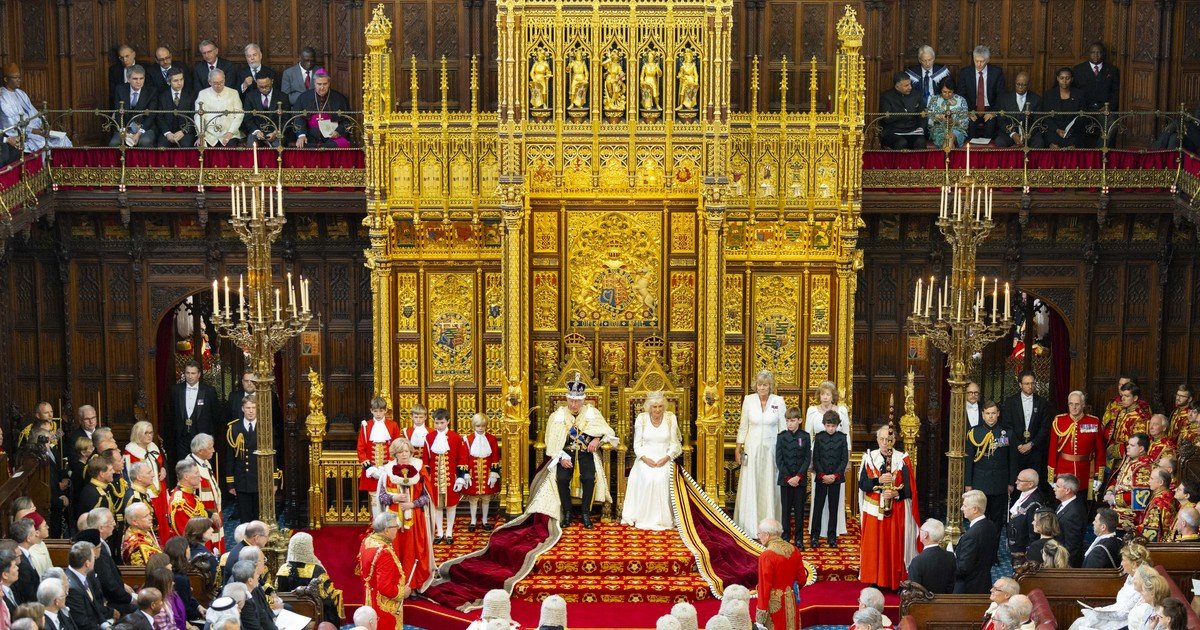
The King’s day carried the constitutional weight. Opening the Senedd is part ceremony, part statement: the monarch binding the nations of the United Kingdom together in person, in Wales, with Camilla beside him. It is the sort of duty that will define Charles’s reign in the history books, and it deserved — and received — an uncontested stage.
Harry and Meghan’s Nottingham outings, their first official joint appearances since moving back to Britain in August, supplied the day’s human pictures. Their presence in the same country, on the same day, doing recognisably royal work for charity, would once have been unremarkable. In 2026, after six years in California and a family rift conducted in bestselling memoirs and documentaries, it counted as news all by itself.
 (Will Thorpe / Wikimedia Commons (CC BY 4.0))
Reading the Silence
Royal historians will recognise the technique. The late Queen’s reign was built on engagements whose power lay in their predictability — the same duties, performed completely, whatever the family weather. William and Kate have absorbed that lesson thoroughly. Their Cornwall morning contained no interview, no statement and no comment on Nottingham or on anything else; it was announced the way consequential work often is in that family, as a fait accompli, with the photographs released once interpretation could do the least damage.
There is also a generational reading. Charles grew up in an era when a royal visit was news simply because it happened; William and Kate operate in an era when attention is the scarcest resource they manage. Spending a full day in Cornwall out of sight, then releasing the story into a clear news cycle, treats attention the way the Duchy treats land — as something to be stewarded, rotated and never exhausted. It is not the loudest strategy available to a future king and queen. On the evidence of Oct. 15, it may be the most effective one.
The Longer Game
Seen from the Waleses’ perspective, Oct. 15 was a small masterclass in the politics of succession. William is the heir; his job is to be ready, loyal and unhurried. Ceding a day’s headlines to his father while advancing his wife’s signature cause — child development, green space, and the science of nature and wellbeing — is precisely what that job looks like when it is done well. The couple’s silence about the Sussexes, maintained even as the brothers worked the same country on the same day, is part of the same discipline.
One palace source, reflecting on the brothers’ estrangement, said of William: “It was very hard on them, and I wouldn’t blame William for being cautious.” Caution, in Cornwall, looked like a community visit nobody photographed until it was over. In a family where every gesture is interpreted, choosing not to gesture at all may be the most fluent royal language of all.