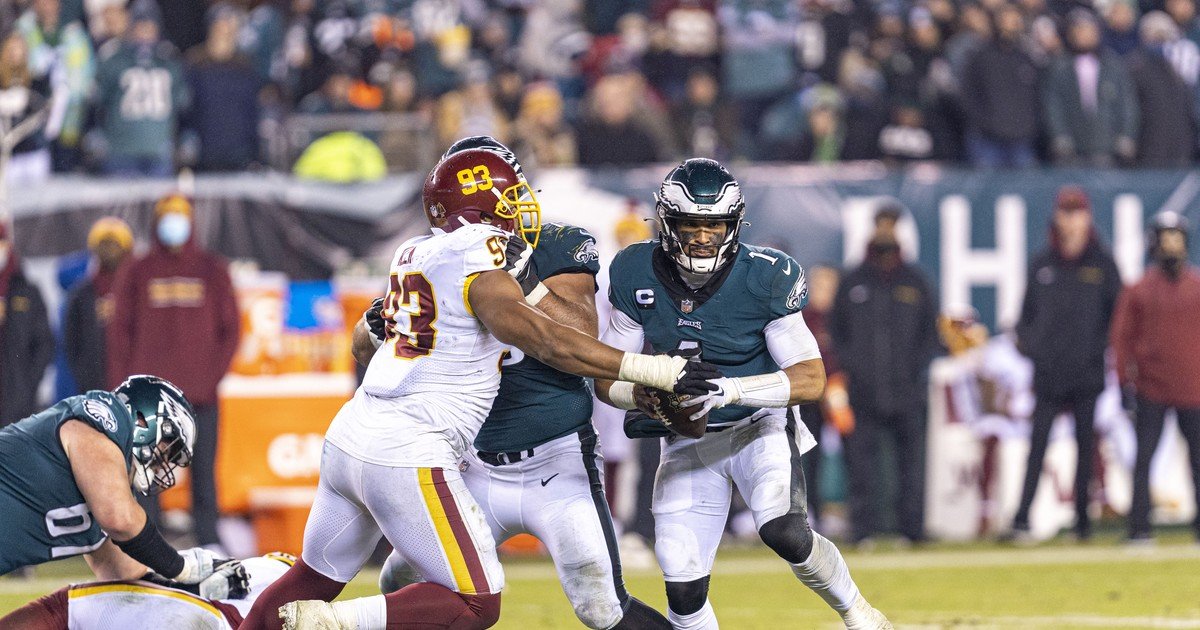
The most important Eagles news of the week was not a trade, a benching or a play call. It was a medical statement. Agent Nicole Lynn confirmed that Jalen Hurts’ condition, initially announced as a superficial blood clot, is actually deep vein thrombosis together with clots in both lungs, ending his season. Treatment will center on Blood Thinners, and the quarterback will not be permitted any contact activities, including football, while he recovers.
Deep vein thrombosis begins when a clot forms in a deep vein, often in the leg. Its danger lies in movement: a piece can break away and travel to the lungs, becoming an Anticoagulant-treated emergency known as a pulmonary embolism. Hurts’ case, per his agent’s statement, involves bilateral emboli — clots in both lungs — yet he is described as clinically stable with no significant functional limitations, and a full recovery is expected.
 (All-Pro Reels / Wikimedia Commons (CC BY-SA 2.0))
How the Diagnosis Unfolded
The sequence raises the stakes of every decision made along the way. Team medical staff first determined Hurts had suffered a blood clot before the Eagles played the Jacksonville Jaguars in London on Sunday, Oct. 11. He received Medical Clearance to play that game, then clearance again to fly eight hours back to Philadelphia with the team. Only days later did monitoring show the clot had moved from his calf and produced multiple clots in his lungs.
Hurts, by his agent’s earlier accounts, had spent a hospital night with no sleep before the London game and played anyway. That detail reframed the week’s discourse entirely. At the same moment a television analyst was wondering aloud whether the quarterback might be exaggerating, the quarterback had in fact been competing in a Contact Sport with a condition that can turn life-threatening without warning.
 (All-Pro Reels / Wikimedia Commons (CC BY-SA 2.0))
Sirianni Defends the Process
Head Coach Nick Sirianni addressed the situation on Monday, defending the team’s handling of a fast-moving medical picture. “The health of our players is always at the forefront of our minds, and we leave that up to the medical experts,” he said, adding that a team built on togetherness and connection is always thinking about the well-being of its players. It was the language of an organization closing ranks around process while its most important player begins a long, quiet recovery.
The role of the Sports Agent became central once the diagnosis deepened. It was Lynn, not the team, who delivered the precise medical update — naming the thrombosis and the bilateral emboli, confirming the blood-thinner treatment and stating plainly that no contact activities will be allowed. In modern football, an agent’s statement is often the most reliable document in the building, and this one set the boundaries for everything the Team Organization could say next.
 (Staff Sgt. Charles Casner / Wikimedia Commons (Public domain))
What the Eagles Lose
On the field, the loss is enormous. Hurts is a former Super Bowl Champion and the face of the franchise, the player around whom the offense, the locker room and the Fan Base all organize themselves. Off the field, his absence will be measured differently: in months of medication, monitoring and patience, with no collisions allowed and no timetable that football people get to negotiate.
The Medical Road Ahead
Recovery from deep vein thrombosis with pulmonary emboli follows a logic that football people find unfamiliar: progress is measured in scans and bloodwork, not in practice reps. Blood thinners will do the central work over the coming months, preventing the existing clots from growing and new ones from forming while the body gradually clears the old. During that period, contact is not a calculated risk but a contradiction, because the same medication that protects Hurts’ lungs makes any significant impact or internal bleeding far more dangerous.
That is why his agent’s statement drew the line so firmly. No contact activities, including football, is not a negotiation opening; it is the treatment itself, stated as a boundary. The encouraging elements of the update deserve equal weight: Hurts is clinically stable, he has no significant functional limitations, and a full recovery is expected. A condition that can be fatal when missed was, in his case, caught, monitored and escalated — later than anyone would wish, but in time for medicine to do its work.
Questions will reasonably continue about the London sequence: a clot identified before the game, a player cleared to compete, an eight-hour flight, and a deterioration discovered days afterward. Sirianni’s defense of the process — that player health sits at the forefront and medical experts make these calls — is the organization’s position, and the full picture may only emerge with time. What is not in question is the standard now set for Hurts’ return: it will be announced by doctors and his agent, on medicine’s schedule, not by a depth chart’s needs.
For the Eagles, the football consequences cascade from that single absence. A franchise quarterback organizes protections, play design, locker-room belief and an entire city’s Sunday expectations, and replacing his snaps is far easier than replacing his gravity. Philadelphia will play on, because seasons do, and backup quarterbacks across the league build entire careers on exactly this kind of sudden summons. But the honest summary of this Eagles year now begins in a hospital corridor rather than a film room, with a stable quarterback, a serious diagnosis, and a recovery that everyone involved agrees cannot be rushed.
As a Professional Athlete, Hurts now faces the strangest assignment of his career — resting. The same competitiveness that carried him through a sleepless hospital night and an international game must now be aimed at stillness. Philadelphia’s season will continue without him, but the story of its year has permanently changed: it is now, first of all, a story about a 27-year-old’s health, and about how close a routine-looking clot came to something far worse.