There is a moment in every great animal story where the human stops trying to fix the animal and starts trying to understand her. For Noëlle Floyd, that moment lasted 25,000 miles. Her docuseries Unbridled, which premiered on YouTube on October 19, follows the trainer and her two horses across North America — and its real subject is not travel at all, but the slow reconstruction of a mare who had every reason not to trust anyone.
Lady’s history is the key to everything that follows. Rescued after spending most of her life feral, she arrived in Floyd’s world with a settled reputation: aggressive, untrusting, difficult. Trainers hear labels like that and understand what they usually mean — a horse whose experiences have taught her that people are unpredictable and best kept at a distance. Floyd’s Horse-First Philosophy starts from the opposite direction: behaviour is information, and the human’s first job is to listen to it.
 (blmcalifornia / Wikimedia Commons (Public domain))
An Education Built for One Student
Floyd’s background matters here. She has built an Equestrian Education platform — podcasts, a magazine, online courses — around the principle that horses learn as individuals. Unbridled applies that classroom logic to a single, demanding pupil. Lady was not put through a standard programme with standard timelines. The journey itself became the curriculum, paced around what she and Galano — G, her steadier travelling companion — could absorb, with each new environment offering a lesson the previous one had prepared them for.
Consider what the road actually asked of Lady the Mare. Near Fort Collins, Colorado, she worked cattle, a job requiring calm focus amid noise, movement and pressure. In Wyoming, she climbed into high, remote country and camped where the night belongs to wildlife. Between those poles came thousands of ordinary miles — trailers, strange barns, unfamiliar ground — each one a repetition of the same foundational lesson: novelty is survivable, and the human beside her is consistent.
 (Tony Webster / Wikimedia Commons (CC BY 2.0))
Trust, Measured in Altitude
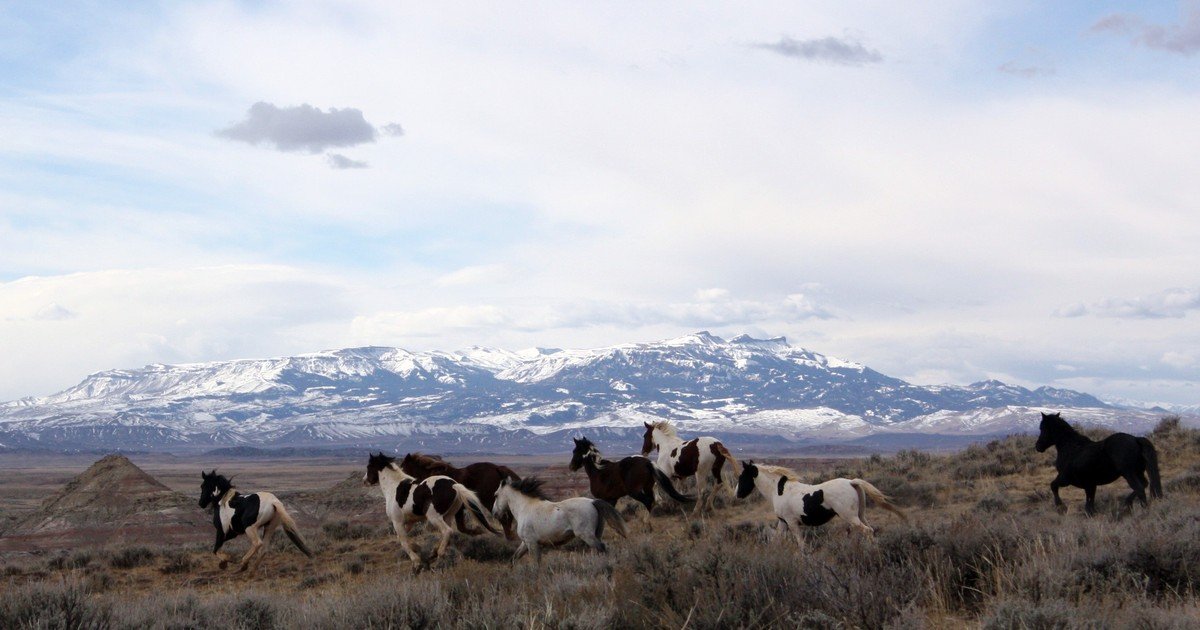
The series’ most eloquent statistic is not the mileage. It is the altitude. At 10,000 feet in the Wind River Range, Floyd camped with both horses untethered — free to leave, choosing to stay. Untethered Camping of that kind cannot be trained in a weekend or faked for a camera. It is Trust Building made visible, the accumulated interest on thousands of small deposits of patience, and it reframes Lady’s entire arc: the mare was never being made obedient. She was being persuaded, at her own pace, that partnership was safe.
Floyd describes the outcome in the language of relationship rather than results. Both horses grew more confident; the Equine Bond between horse and human deepened. Anyone who has worked with a fearful animal will recognise the significance of the order she puts those in — confidence first, because a confident horse is not a controlled horse but a settled one, and settlement is what Lady’s feral beginnings had never allowed her.
 (GoShow / Wikimedia Commons (CC BY-SA 3.0))
Why the Journey Worked
A Mountain Trail teaches what an arena cannot: consequences are real, footing matters, and the partnership is load-bearing. But Unbridled’s deeper argument is about time. A Wild Horse learns the world in seasons, not sessions, and Floyd essentially gave Lady a season of world — 25,000 miles of it. The Mustang spirit in a formerly feral mare is not a flaw to be trained out; treated with respect, it becomes the very engine of her confidence, because a horse who chooses to stay has learned something no restraint could teach her.
That is why the series lands beyond the equestrian audience. Strip away the trailers and the tack, and Unbridled is a story about how trust is actually built between any two creatures: slowly, consistently, and mostly on the road between the places you planned to go.
The Supporting Actor With Four Legs
Galano deserves more credit than supporting players usually get in stories like this. Horses regulate each other constantly — a calm companion lowers a fearful horse’s heart rate, models curiosity at strange objects, and demonstrates, in the only language Lady fully trusted, that the trailer, the strange barn and the high camp are survivable. Floyd understood this and built it into the expedition’s design. Lady was never asked to be brave alone. She was asked to be brave next to G, with a human present who had made a career of not rushing the process. That structure — companion, consistency, time — is the journey’s actual technology, and it requires no equipment more advanced than patience.
A Series That Trusts Its Audience
Unbridled also makes an editorial bet worth naming: it assumes viewers can handle slowness. Reality formats usually compress animal training into breakthrough montages because producers fear audiences will drift. Floyd’s series lets change arrive at the speed it actually arrived, and the gamble pays off in the Wyoming sequence, where a single quiet night carries more emotional weight than a season of manufactured climaxes. The audience is not being sold a miracle. It is being shown a method — and methods, unlike miracles, can be taken home and used.
That may be the series’ longest-lasting effect. Somewhere, a viewer with a difficult rescue horse of their own is watching Lady sleep loose under Wyoming stars and recalculating what their horse might become, given miles instead of deadlines. Floyd has built a career on exactly that recalculation. Unbridled is simply its longest, most beautiful lesson.
The production’s structure quietly reinforces its thesis. Six episodes is long enough for viewers to form their own attachment to Lady — to wince at her early defences and feel the Wyoming camp as a personal victory rather than a plot point. By the finale, the audience has been through a version of Floyd’s own process: hundreds of small observations adding up to trust. A series about patience that also teaches patience, almost by osmosis, is a rare thing in any genre. In the horse world, it may prove to be a landmark.