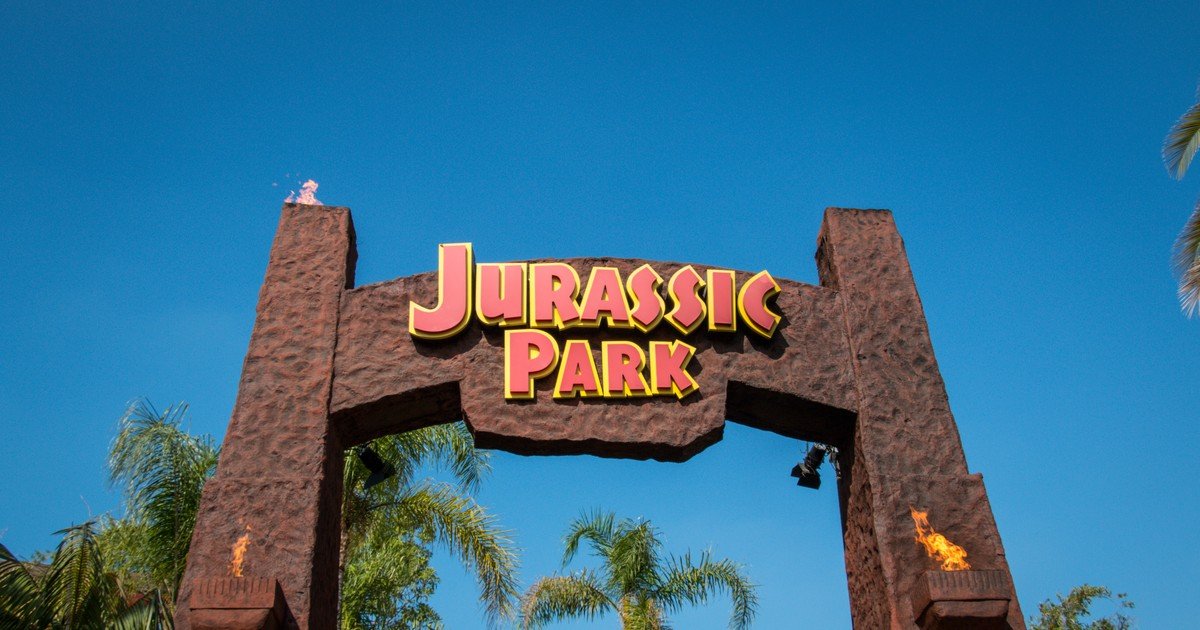
Most families carve a pumpkin and call it Halloween. The Warner family built a national landmark in their driveway. Over more than 200 hours of designing and building — and at a cost of roughly $4,000 — Rob Warner, his wife Kel Warner and their three children have transformed their home into a real-life Jurassic Park, complete with a 13-foot-tall replica of the film’s legendary gates towering over the street.
The centrepiece of the family’s Halloween Display is the Jurassic Park Gates Replica at the end of the driveway — taller, the family notes, than the house behind it. Working Fake Flame Effects flicker above the entrance, recreating the torch-lit arrival that opens Steven Spielberg‘s movie, and setting the tone for everything inside.
Two Hundred Hours of Dinosaur Devotion
The numbers behind the project read like a small construction contract. The family estimate they have spent more than 200 hours designing and building the display, and about $4,000 in total, including new tools and a 3D printer purchased for the job. Wood ranked among the biggest expenses. Costs were kept in check the old-fashioned way: props, special effects, audio equipment and lighting from the family’s previous Halloween displays were repurposed throughout the build.
 (Benoît Prieur / Wikimedia Commons (CC0))
The Driveway Entrance is more than decoration. The gates mark the way into the family’s annual Halloween Party, and have become a popular photo spot for neighbours and passersby, who stop to pose beneath the flaming arch as if they were arriving at the park itself.
A Whole Family on the Tools
This was no solo obsession. Kel explains that the children help throughout, working under their parents’ direction and contributing ideas of their own that get built into the display. Their middle son helped with the 3D prints and assembled the insulator pieces for the electric fence; all three children helped paint and glue together the gate doors. The children’s grandfathers joined the workforce too, using the project to teach their grandchildren practical, hands-on skills.
 (Gage Skidmore from Peoria, AZ, United States of America / Wikimedia Commons (CC BY-SA 2.0))
The Hardest Part: Getting It Right
Asked about disasters, Kel is cheerful: there were no real ones. There were, however, several rounds of design changes as the family worked out how to pull off what they wanted — and pull it off accurately. That accuracy, she says, is the hardest part of the entire project. The Jurassic Park 1993 Film is so iconic and so well-known that every visitor arrives with the original gates, fence and atmosphere already memorised. Near enough, for a family of self-described detail-oriented people, was never going to be good enough.
The original film, directed by Spielberg and starring Sam Neill, Laura Dern and Jeff Goldblum, arrived in 1993 and became a phenomenon, launching a franchise of sequels and theme-park attractions. Three decades later, its gates remain one of cinema’s most recognisable entrances — which is precisely why a 13-foot homemade version, built by three generations of one family, stops traffic.
 (Rjcastillo / Wikimedia Commons (CC BY-SA 4.0))
Halloween, Theme-Park Scale
By the time the flames are lit and the first guests arrive, the Warner home has effectively become the smallest theme park in the neighbourhood — admission free, photography encouraged. The family say the project brought its own reward long before Halloween night: hundreds of hours of parents, children and grandfathers building something together, one insulator, one painted gate door and one very large wooden entrance at a time.
Built From Halloweens Past
The Jurassic Park transformation did not emerge from nowhere. The Warners are serial Halloween builders, and this year’s display deliberately harvested the family’s history: props constructed for earlier Octobers were reworked into the new design, while special effects, audio equipment and lighting from previous displays were redeployed rather than replaced. The result is a display with ancestors — a park built, fittingly, on the fossil record of the family’s own front yard.
That recycling was partly financial wisdom and partly something else: continuity. Returning visitors who remember earlier displays can spot familiar elements wearing new costumes, the way film fans spot the same studio backlot in different movies. For the family, each reused prop is also a memory with screws in it.
The Fence, the Flames and the Finishing Touches
Beyond the gates, the build’s detail work is where the 200 hours went. The electric fence — the park’s other signature structure — required its insulator pieces to be fabricated and assembled one by one, a job the family’s middle son took on with the 3D printer. Audio and lighting, salvaged from earlier displays, supply the atmosphere that photographs cannot capture: the sense, standing at the driveway on a dark October evening, that something very large might be breathing just out of sight.
Even the flames are a small engineering brief of their own. Real fire above a wooden gate in a residential street is obviously out of the question, so the family built working flame effects that read, from the pavement, as torches — the detail that completes the film’s most famous arrival shot and turns passing cars into an audience.
A Landmark by Halloween Night
By the time Halloween arrives, the display will have completed its transformation from family project to public attraction. The gates serve as the entrance to the family’s annual party, but they also serve the street: a photo opportunity for neighbours, a destination for trick-or-treaters, and proof that the spirit of Spielberg’s film — ordinary people building something impossible in the face of every sensible objection — is alive and well and living at the Warners’ address.
An Invitation, Not Just a Display
The family are keen to stress that the display exists to be visited. The gates are an entrance in the fullest sense — to the party for invited guests, and to the experience for everyone else who wanders up the driveway with a phone in hand. In a season when many spectacular displays sit behind ropes and keep-off-the-grass signs, the Warners built theirs to be walked through, posed under and remembered: Jurassic Park, after all, was always meant to have visitors. Preferably, this time, ones who make it home safely.