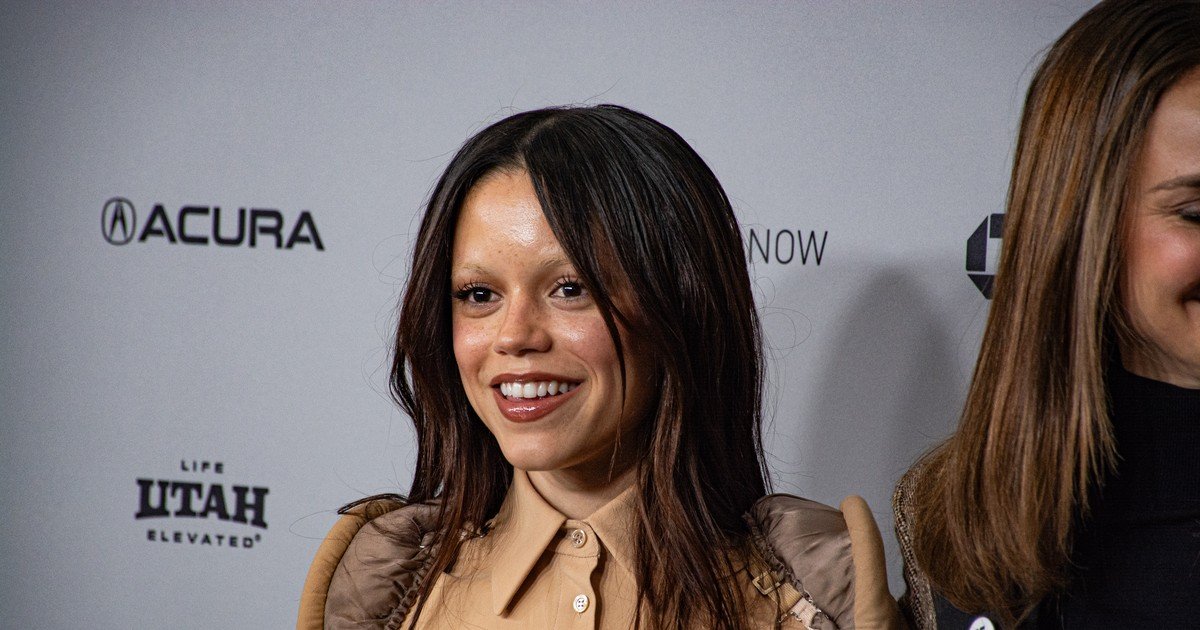
To understand Jenna Ortega’s Halloween, you have to understand that for her it was never a minor holiday. Appearing on Late Night with Seth Meyers on October 19, 2026, the 24-year-old star of Wednesday and Beetlejuice called Halloween her favourite holiday — and backed the claim with a costume history that reads like a museum exhibition: a homemade rock, Björk‘s swan dress, and the Invisible Man. Taken together, the three costumes form a small biography of the actress the world now knows as its reigning scream queen, and they explain why her relationship with spooky season runs deeper than branding.
Start with the rock, because Ortega did. As a child, she built the costume herself from a block of styrofoam bought at Hobby Lobby, spray-painted it grey, and — when it became clear that no one could identify her — finished it with a headband that said “rock.” It is a funny story, and Meyers’ matching tale of his father’s trash-bag costume (mistaken for leaves; his error, he joked, was the lack of a “garbage” headband) made it funnier. But it is also a document of intent. This was a child who did not want to be a generic ghost. She wanted a concept, and she was willing to annotate it.
The Swan Dress: A Fashion History Deep Cut
The second costume belongs to an entirely different register. Björk’s swan dress, worn by the Icelandic singer to the Academy Awards in 2001, is one of the most famous red-carpet garments ever worn — part gown, part sculpture, mocked at the time and canonised since as a masterpiece of fashion risk. That a young Ortega chose to recreate it says something specific about her taste: she has always been drawn to the theatrical, the handmade-looking and the slightly unhinged, long before the fashion world started dressing her in exactly that spirit. It is less a costume than an homage, and it connects her childhood dress-up instincts directly to the gothic glamour she now wears to premieres.
 (Gabriel Brooks / Wikimedia Commons (CC BY 4.0))
Then there is the third: The Invisible Man, the classic figure of horror film history — bandages, sunglasses, and a presence defined by absence. Of the three costumes, it is the most prophetic. Ortega’s career has been built inside horror and its neighbours, from the Scream franchise to Wednesday’s deadpan gothic, and her take on the genre is unusually literate: she plays these roles like someone who grew up studying them. A child who dresses as the Invisible Man is not dabbling in Halloween. She is doing research.
Why It Resonates Now
The timing of the interview is part of its charm. Halloween is a genuine cultural season now, and no young star owns it the way Ortega does; her association with Wednesday — and with the Addams Family’s year-round Halloween — has made her the holiday’s unofficial ambassador. Stories like the rock costume work because they authenticate that status. Anyone can be styled as a goth for a photoshoot. It takes a true believer to have once been a labelled piece of scenery, and to still, at 24, tell the story with pride on national television.
 (Irene Suwandi / Wikimedia Commons (CC BY 3.0))
There is also a broader lesson in the trio of costumes about how stars are made. Ortega’s public persona — dark, dry, devoted to the macabre — could easily read as a marketing construction, the kind assembled by stylists once Wednesday became a hit. The Halloween archive proves otherwise. The swan dress shows the fashion obsessive; the Invisible Man shows the horror student; the rock shows the comedian willing to look ridiculous. The costume design of her childhood was, in effect, the first draft of the star.
What happens next is predictable and delightful: the interview clip will circulate through Halloween week as a pop culture moment, fans will stage their own annotated rocks and garbage-bag tributes, and Ortega’s reign over the season will tighten further. Few actors get to be the face of a holiday. Fewer still earned it with a block of styrofoam, a can of spray paint, and a headband doing the heavy lifting. Long may she reign — the Halloween tradition is in excellent hands.
 (ATTN: / Wikimedia Commons (CC BY 3.0))
The Pattern in the Wardrobe
Look at the three costumes as a set and a pattern emerges that goes beyond taste. Each one is a transformation into something that is not, strictly speaking, a person at a party: an object, a garment that became a legend, a man who is not there. Most children dress as who they want to be; Ortega dressed as ideas. That appetite for concept over character is visible everywhere in her mature work — in performances built on restraint and odd angles, and in a fashion presence that treats every carpet as an opportunity to wear the argument rather than the outfit. The wardrobe was never a phase. It was a draft of an artistic identity, assembled annually, from foam, feathers and bandages.
There is a lesson in it for anyone who works in a visual medium: the audience remembers commitment, not budget. A block of styrofoam, clearly believed in, has outlasted a thousand expensive costumes that nobody can now recall. Ortega understood that before she had a stylist, a publicist or a franchise — and the fact that she still tells the story, at the height of her fame, in the middle of Halloween season, suggests she intends to keep the understanding. The rock comes first. Everything since has been a variation.
Somewhere, presumably, the headband still exists — or deserves, at minimum, a place in the eventual museum exhibition of her career, mounted beside the swan dress recreation and an empty space labelled, in her honour, the Invisible Man.
Until then, the crown is informally hers: the rare star whose Halloween credentials were earned the hard way — in a craft-store aisle, with spray paint on her hands and a label on her forehead, years before anyone thought to call her a scream queen at all.