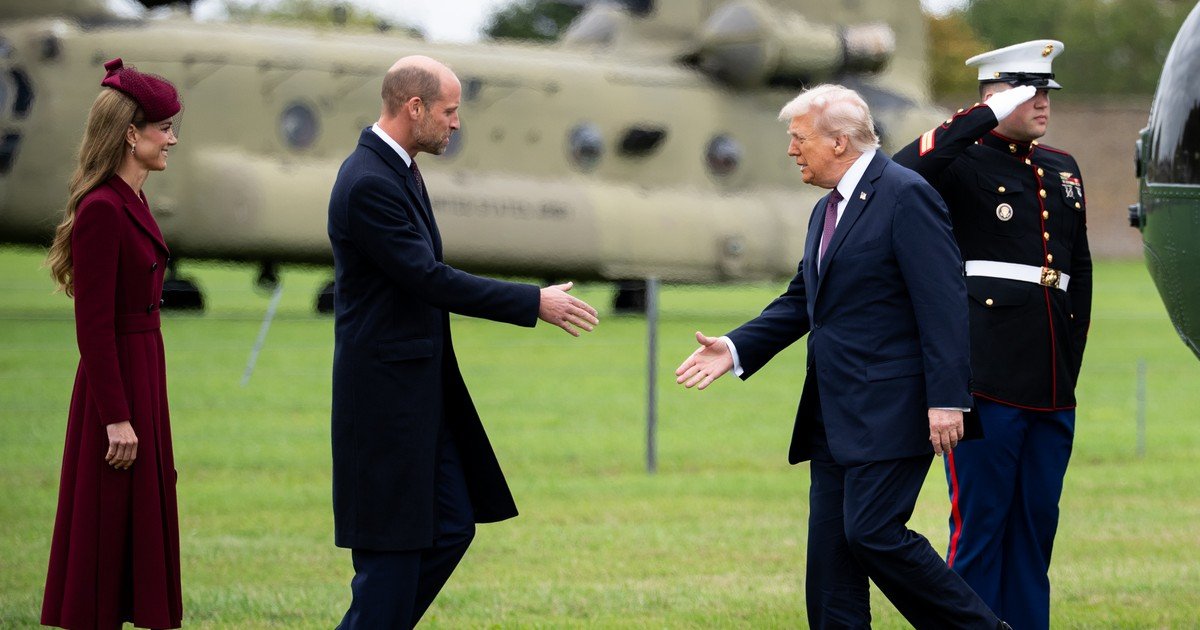
Windsor Castle does ceremony the way other places do weather — constantly, and better than anywhere else. On Tuesday, October 20, the castle staged the full production once again as Prince William and Kate Middleton joined King Charles and Queen Camilla to formally welcome Sultan Haitham bin Tarik of Oman at the start of his state visit to the United Kingdom — a day of carriages, cannon fire and one very deliberate green coat.
The choreography began away from the cameras. William, acting on behalf of his father the King, first greeted the Sultan at his London residence, then accompanied the visiting head of state to Windsor for the official welcome. There, on the Royal Dais along Datchet Road, the full royal welcoming party — King Charles III, Queen Camilla, William and Kate — received the Sultan before a horse-drawn carriage procession carried the party through the town and up to the castle.
 (U.S. Department of State / Wikimedia Commons (Public domain))
Salutes Over Two Skies
A state visit is the highest form of royal hospitality Britain offers, and its soundtrack is artillery. As the welcome unfolded, a royal gun salute was fired in the Home Park at Windsor, while a second salute echoed across London from the Tower of London — twin volleys bracketing the day in a tradition that stretches back centuries. For the crowds gathered along the route, the booming guns and the gleaming procession delivered the essential Windsor spectacle: part military precision, part theatre, entirely unmistakable.
The division of labor on display was itself a message. The King and Queen hosted; the Prince and Princess of Wales performed the meeting-and-escorting duties that increasingly define their role as the monarchy’s next generation. William’s solo mission to the Sultan’s residence — greeting the guest before the guest had even arrived — is the kind of quiet, senior task that marks how far the future king has moved to the center of these occasions.
 (Mike McBey / Wikimedia Commons (CC BY 2.0))
The Green Coat Everyone Is Talking About
And then there was Kate’s outfit, which did what Kate’s outfits at state occasions are designed to do: say something without saying a word. The Princess of Wales wore a deep green coat by Sarah Burton for Alexander McQueen — Burton being the designer of her 2011 wedding dress, a choice of house that always carries personal resonance — finished with a hat by Juliette Botterill.
The color was the headline. Green is one of the colors of Oman’s national flag, and royal watchers immediately recognized the gesture as a textbook piece of diplomatic dressing: the host wearing the guest’s colors as a silent compliment. It is a language Kate has spoken fluently for years, and on Tuesday she spoke it in full sentences — heritage British designer, impeccable tailoring, and a shade of green that photographed like a flag.
 (The White House / Wikimedia Commons (Public domain))
A Family Firm, Working in Formation
What seasoned royal watchers noticed most on Tuesday was the formation. The King and Queen received the guest of honor at the dais, as hosts and heads of the house. The Prince of Wales performed the personal escort — collecting the Sultan in London, riding with him to Windsor — the role once filled by the late Duke of Edinburgh and, before him, by generations of heirs learning the family trade by doing it. And the Princess of Wales supplied the day’s defining image and its quiet diplomatic footnote, in the form of a coat chosen to honor the guest’s own flag.
This distribution of roles is the modern monarchy’s operating system made visible. No single figure carries a state visit anymore; it is staged as a family enterprise, with each generation contributing what it does best. The result is both practical and symbolic: the institution demonstrates depth, the heir gains statecraft hours in front of the world, and the guest is honored not by one royal but by the whole house at once. Photographs from Datchet Road captured all of it in a single frame — the visitor flanked by the present and future of the Crown.
The setting amplifies everything. Windsor is not a museum the royals borrow for big days; it is the sovereign’s home, the castle where the King keeps his court for much of the year and where the family gathers for its most traditional occasions. Welcoming a sultan there, rather than in a London palace alone, lends the visit an intimacy that visiting delegations consistently remark upon: the sense of being received not merely by a state, but at home by its head. Statecraft has few settings that can make that claim, and none with a thousand years of practice.
Why This Visit, Why Now
State visits are never only about pageantry. They are instruments of statecraft, reserved for relationships a government wants to honor and deepen, and the full Windsor treatment — the dais, the carriages, the double gun salute — signals that Oman’s Sultan is being received at the very top of the diplomatic register. The ceremony at Windsor is the visible tip of an agenda of trade, security and regional diplomacy that officials will pursue in the meetings surrounding the spectacle.
The day’s guest brings his own weight to the occasion. Sultan Haitham, who came to Oman’s throne in 2020 after a career in diplomacy and cultural administration, leads a country that has built an outsized reputation as the Gulf’s quiet intermediary — a state whose friendships are cultivated carefully and kept for decades. Britain counts itself among the oldest of those friendships, with ties running back through centuries of maritime trade and treaties. A welcome of this magnitude is therefore not an introduction; it is a reaffirmation, staged for a partner whose regional counsel London values and whose discretion it has learned to rely on. The Sultan’s presence at Windsor, received at the highest ceremonial level the British state can offer, told every observer in the region exactly where Oman stands in London’s order of esteem.
For the royals, days like Tuesday are also a demonstration of continuity. Two generations of the family appeared in one frame: the King presiding, the heir escorting, and the Princess of Wales deploying the soft-power wardrobe for which she has become famous. Windsor has welcomed sultans, presidents and emperors for a thousand years. On the evidence of October 20 — the crowds, the carriages, the coat everyone will remember — it has lost none of its touch.